
Church of Saint Nicholas Nadein
Exterior


Interior






One of the richest historic towns on the Volga River is Yaroslavl, located 150 miles northeast of Moscow. Although today it is an industrial center with some 650,000 inhabitants, Yaroslavl has a remarkable concentration of church art and architecture from the 16th through the 19th centuries. Each year, thousands visit the city on river cruises or by land from Moscow.
In the latter part of the 16th century, Ivan the Terrible established a port at the Archangel Monastery (Arkhangelsk) on the Northern Dvina River near the White Sea with the goal of opening Muscovy for commerce with western Europe. This enhanced Yaroslavl’s position within a mercantile network that stretched from the White Sea to Siberia and the Orient. With new trading possibilities, Yaroslavl attracted colonies of Russian and foreign merchants (English, Dutch, and German).
Although spared the catastrophic disorder inflicted on Russia in the latter part of Ivan the Terrible’s reign, the commerce of Yaroslavl declined during the interregnum following the death of Tsar Boris Godunov in 1605. Known as the Time of Troubles, this period of political and social chaos saw much of the country plundered. Nonetheless, Yaroslavl again eluded the worst of the cataclysm and in 1612 served as a rallying point for national resistance against a Polish occupying force in Moscow.
One of the most prominent of the merchant participants was Nadeya (formally known as Epifany) Sveteshnikov (ca. 1580-1646), who reaped the benefits of Russia’s late 16th-century trading expansion. His major sources of wealth included trade in furs from Siberia and salt refining along the middle Volga River.
In 1611-12, he and other Yaroslavl merchants providing substantial material support for a people’s army led by Prince Dmitry Pozharsky and Kuzma Minin. In fall 1612, this army decisively defeated Polish forces that had occupied Moscow in support of a Polish claimant to the Muscovite throne.
The expulsion of the Polish-Lithuanian forces from Moscow paved the way for the founding of the Romanov dynasty the following year. The participation of Yaroslavl’s merchants in this campaign of national revival brought extensive trading privileges during the reign of Michael, first tsar of the Romanov dynasty. Among the primary beneficiaries was Nadeya Sveteshnikov.
With his expanded wealth, Sveteshnikov initiated a laudable17th-century practice of merchant support for the construction of parish churches throughout the neighborhoods of Yaroslavl. During this period, 44 masonry churches were erected within the area’s 35 parishes. Only Moscow could rival Yaroslavl in its concentration of new churches, sponsored by a combination of wealthy merchants, local districts and trade associations.
The earliest of these shrines was the church that bears Sveteshnikov’s first name, St. Nicholas Nadein, begun in 1620 and consecrated in 1622. Built near the high right bank of the Volga on the eastern edge of the ancient town, the St. Nicholas Nadein Church originally had five cupolas in a design characteristic of Russian church architecture from the mid-16th century.
Distinctive features of the church included domes clad in contoured glazed ceramic tiles. A bell tower anchored the northwest corner of the main structure, which was elevated on an arcaded base. This ground level served as a burial crypt for the Sveteshnikov family as well as a storehouse for his valuable commercial goods.
In a gesture typical of merchant donors, Sveteshnikov included a chapel for the sole use of his family. Dedicated to the Annunciation, the chapel was attached to the northeast corner of the main structure.
Subsequent modifications to the church over the next century included the dismantling of the four secondary cupolas and the leveling of the roof line. The corner bell tower was expanded in the 1690s with an additional, octagonal tier and a tall “tent” cap, which became the dominant visual feature of the church. Shortly thereafter, a small chapel dedicated to St. Alexander of Svir was attached to the south side of the structure.
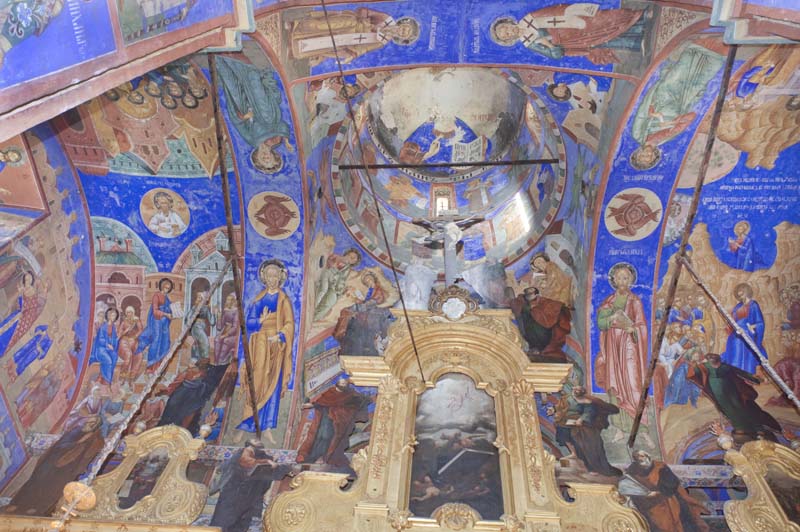
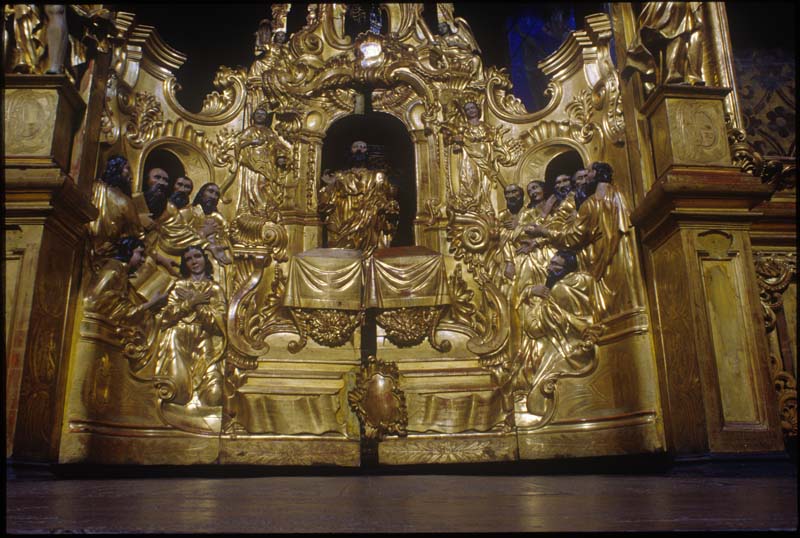
The interior of the church was painted in 1640 by a group of artists guided by Liubim Ageyev, a master painter from Kostroma down the Volga River. The many painted subjects were arranged in five registers (levels) that include episodes from the life of St. Nicholas as well as Biblical scenes. In the late 19th century, these frescoes were “refreshed” (repainted) in close conformity to the original 17th-century outlines.
Despite its several modifications, the St. Nicholas Church has remained a major example of merchant patronage of the arts in Yaroslavl. Unfortunately, the fate of Nadeya Sveteshnikov took a radical turn for the worse in 1645 with the accession to the throne of Tsar Aleksei Mikhailovich Romanov, who coveted Sveteshnikov’s profitable salt refineries. Accused of improper use of state property, Sveteshnikov was hauled to Moscow for interrogation in 1646. Already in his sixties, Sveteshnikov succumbed to the public humiliation and physical punishment. He was buried in the crypt of the church that he had built.
With the establishment of Soviet power, the St. Nicholas Church was closed in 1930 and transferred to the local history museum, which preserved it from demolition. Restoration campaigns have occurred on a regular basis since the 1950s—part of the incessant labor necessary to preserve the merchant Nadeya’s greatest treasure.
Text by William Brumfield, Link to full article: https://www.rbth.com/travel/332419-st-nicholas-nadein-yaroslavl