
Church of the Dormition
Exterior
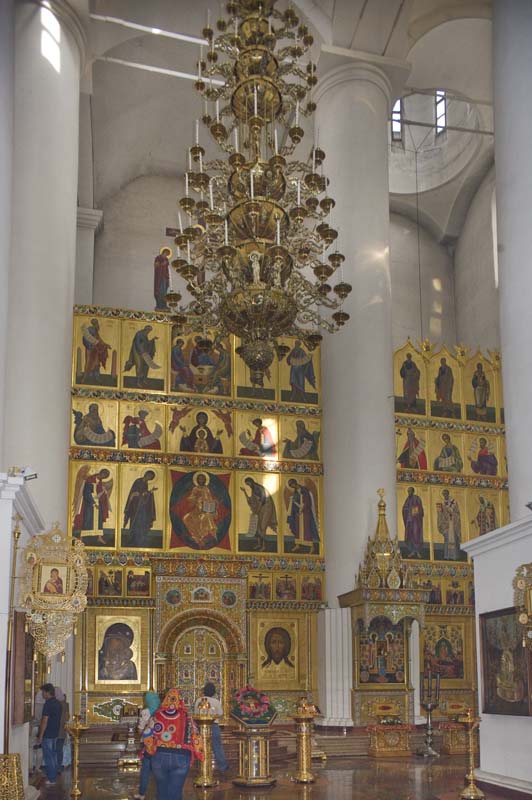
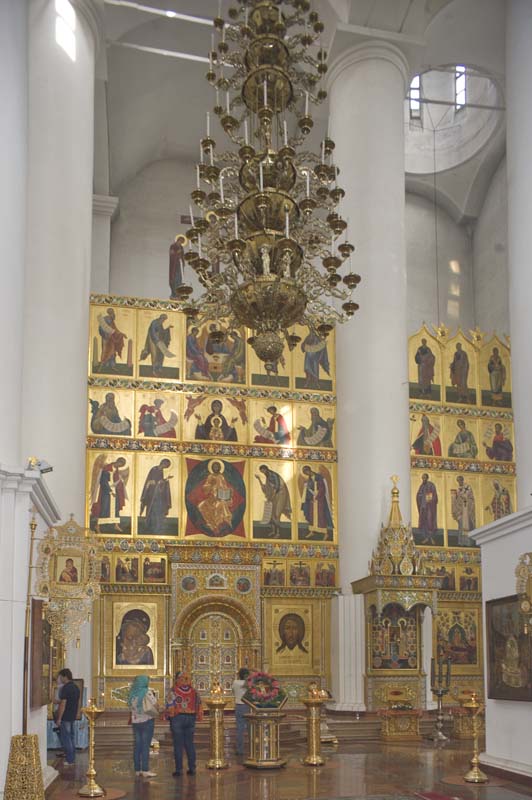
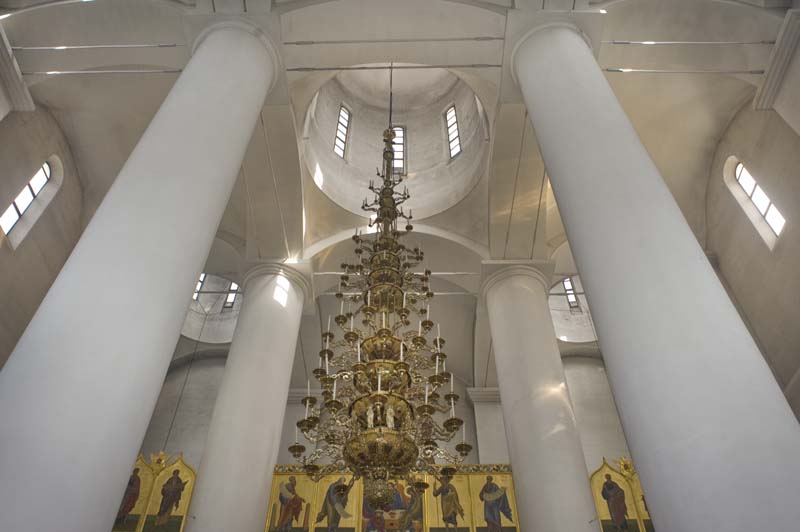
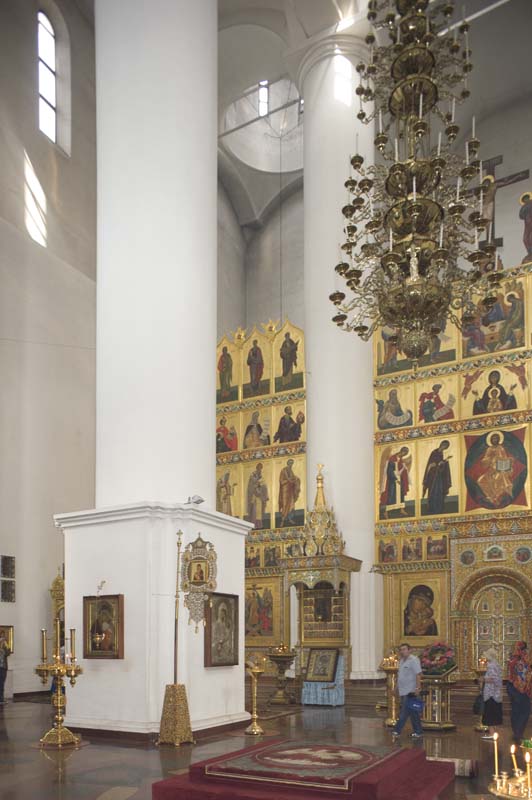
Interior
Yaroslavl is now a large regional center (population around 600,000) with an extensive industrial base anchored by petrochemicals. But fortunately, its historic monuments have been preserved. The town’s beauty is enhanced by its location on a tree-lined embankment overlooking the Volga.
The central ornament of this boulevard was the town’s main cathedral, dedicated to the Dormition of the Virgin. The fate of this structure reflects Russia’s turbulent history over the past century to a degree matched by few others.
Yaroslavl was founded in the early 11th century by the Kievan grand prince Yaroslav the Wise–one of the greatest rulers of medieval Rus. By the early 13th century, the settlement had monasteries with masonry churches. In 1238, it was sacked by the Mongols during their conquest of central Russia. Although recovery from Mongol dominance was slow, union with Muscovy in the 15th century integrated the town into a larger political and economic structure.
Yaroslavl’s location allowed it to serve as a center not only for trade within the vast Volga River basin, but also for exploitation of the forested expanses of the Russian north. In the latter part of the 16th century, Ivan the Terrible established a port at the Arkhangel Monastery on the Northern Dvina River near the White Sea and thus opened Moscow for commerce with western Europe.
This enhanced Yaroslavl’s strategic position within a mercantile network that stretched from the White Sea to Siberia and the Orient. With new trading possibilities, Yaroslavl attracted colonies of Russian and foreign merchants (English, Dutch, and German).
Although spared the worst of the disorder inflicted on Russia in the latter part of Ivan the Terrible’s reign, Yaroslavl’s role as a commercial center declined during the interregnum following the death of Boris Godunov in 1605. Known as the Time of Troubles, this period saw much of the country plundered in the course of political and social chaos. Yaroslavl again eluded the worst of the cataclysm, and in 1612 the city served as a center for rallying national resistance against a Polish occupying force in Moscow.
The active participation of Yaroslavl’s merchants in this campaign brought them extensive trading privileges from the government of the new ruler, Mikhail Fyodorovich, first tsar of the Romanov dynasty. Consequently, during the 17th century the city not only accumulated the wealth necessary to build elaborately decorated churches, but also established connections with cultural centers to the west.
Only Moscow could rival Yaroslavl in its concentration of new churches, sponsored by a combination of wealthy merchants, city districts, and trade associations. In Yaroslavl during the 17th century, 44 masonry churches – most of considerable size – were erected within the area’s 35 parishes.
The largest among the shrines was the town’s main cathedral, dedicated to the Dormition of the Virgin and originally built of brick in the early 13th century during the reign of Prince Konstatin Vsevolodovich of Rostov.
That structure was rebuilt multiple times before the mid 17th century, when Tsar Alexei Mikhailovich commanded that it be rebuilt on a different site overlooking the Volga. The cathedral that Prokudin‑Gorsky photographed was erected in the 1660s, with numerous modifications made over the next two centuries.
In its design, the structure resembled the Dormition Cathedral in the Moscow Kremlin (1470s), particularly as reiterated in other large cathedrals during the 16th century. The facades are accented with blind arcading and culminate in semi-ciruclar gables known as zakomary. These gables were partially obscured by a level roofline, perhaps a later modification. The structure was crowned by five large domes.
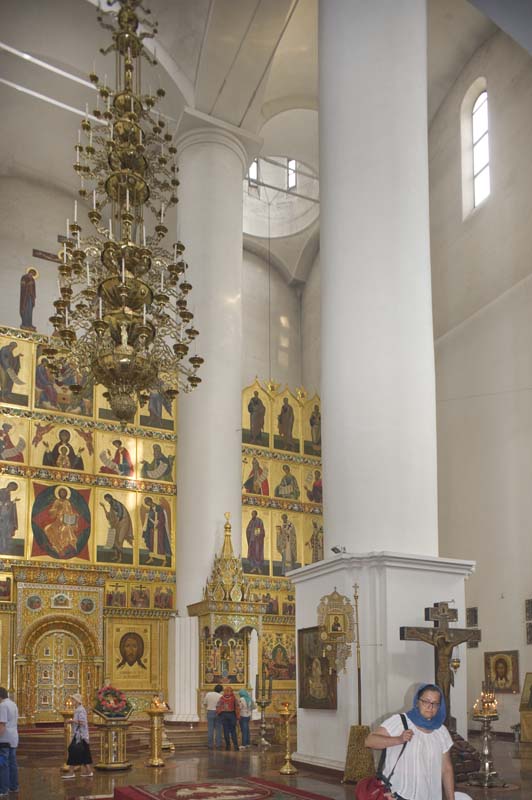
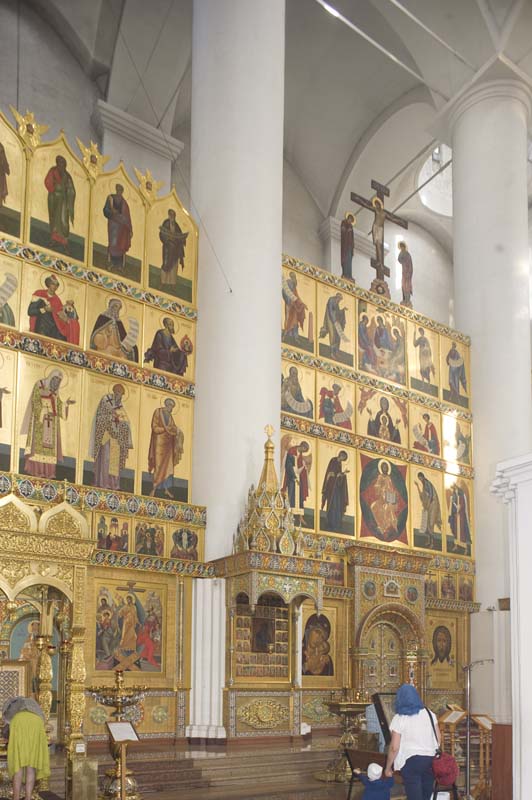
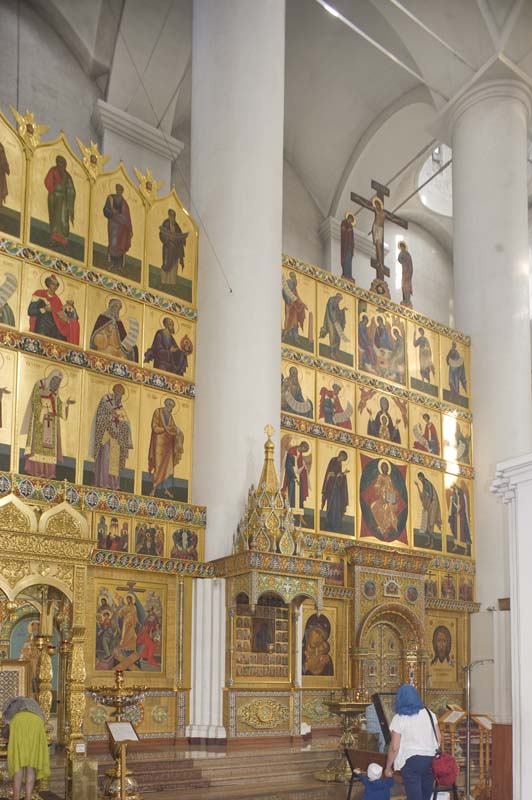
The interior also bore a resemblance to the main Moscow cathedral, with a similar plan and walls covered with frescoes painted in 1671-74. A distinctive local feature was the addition of decorative porches to the main facades.
An adjacent four-tiered bell tower was completed in 1836 to a design in the Russo-Byzantine style by the architect Avraam Melnikov. Also in the 19th century, exterior frescoes on the upper parts of the facades were repainted in an academic style.
During a two-week Yaroslavl uprising against the Bolsheviks in July 1918, the Dormition Cathedral was heavily shelled. Partially repaired in the early 1920s, it was closed in 1929 and all later additions were removed from the core 17th-century structure—perhaps a prelude to museification. Instead, the cathedral was demolished at the height of the Stalinist repressions in 1937 and the site converted to a park.
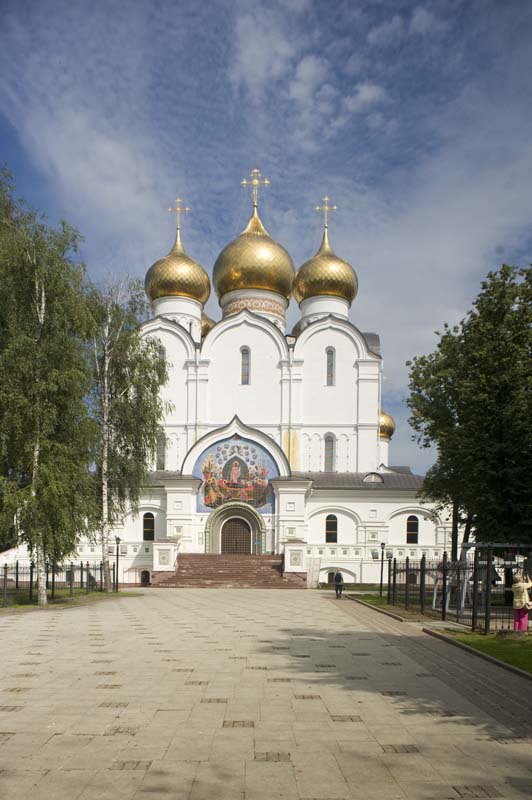
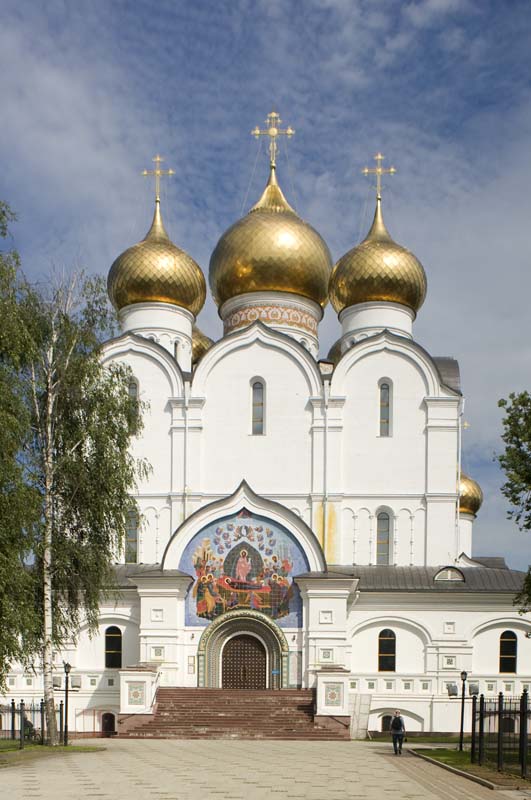
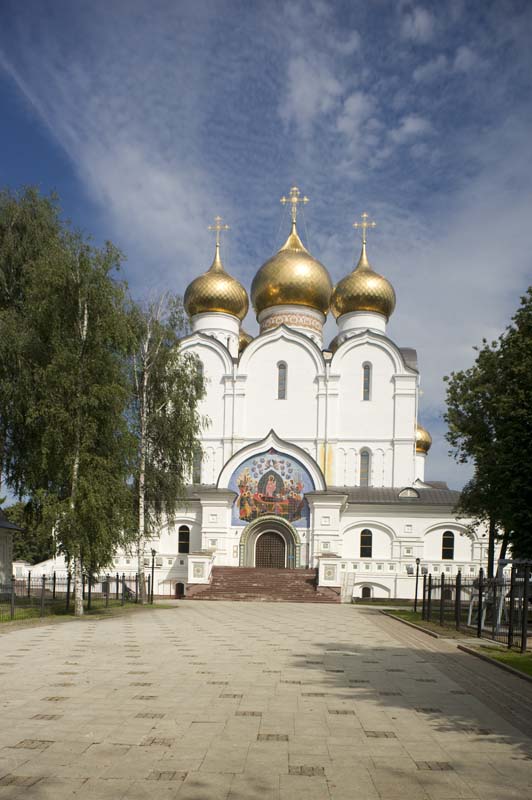
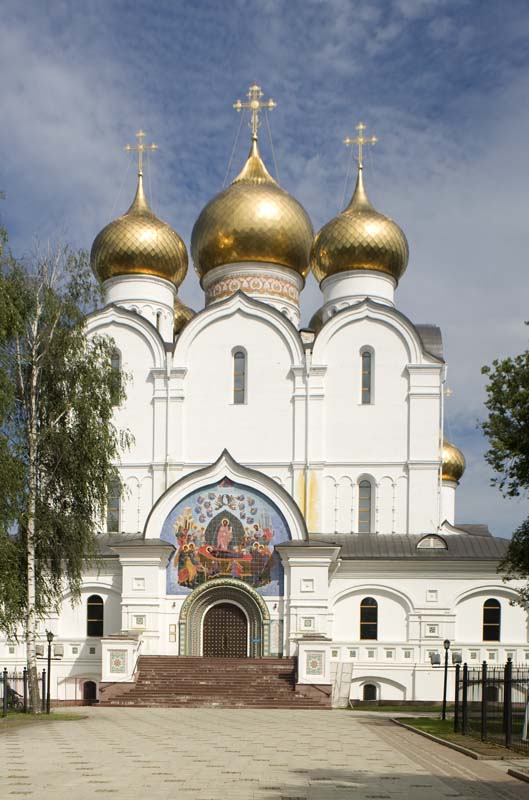
In 2004 a campaign to rebuild the shrine was launched with major financial support from a Moscow entrepreneur. Designed by the Moscow architect Alexei Denisov, the new cathedral was built in 2006-12. The outline of its central form resembles the Moscow Dormition Cathedral, with blind arcading on the facades and unobstructed zakomara gables visible in my 2017 photographs.
The new structure lacks the highly ornamented porches, although it has chapels attached to the north and south facades. Some preservationists objected to the larger scale of the new structure and the lack of particular stylistic features of the 17th-century cathedral.
Text by William Brumfield, Link to full article: https://www.rbth.com/travel/329728-yaroslavl-dormition-cathedral